


[챕터1] 김창호
KOR
ENG
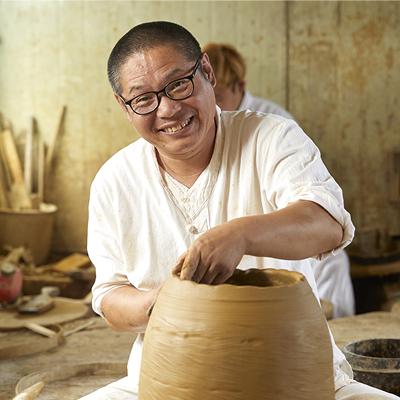
김창호는 경기도 여주에서 전통 옹기를 현대적인 조각으로 확장해 온 작가입니다. 옹기는 장과 김치 같은 발효 음식을 보관해 온 한국의 전통 그릇으로, 공기와 수분이 오갈 수 있어 흔히 ‘숨 쉬는 그릇’이라 불립니다.
작가는 국가무형유산 옹기장인 아버지 김일만 선생에게 옹기 제작의 전 과정을 배웠습니다. 하지만 그가 이어받은 것은 기술만이 아닙니다. 흙을 만지고 형태를 세우는 손동작과 호흡, 반복되는 리듬까지 몸으로 익혀 자신의 작업에 담아왔습니다.
〈생성〉 연작은 여러 형태의 흙 기물을 쌓고 배치해 만든 작품입니다. 눈앞에 모여 있는 형태들을 하나씩 살펴보세요. 낮고 둥근 것부터 길게 솟은 것까지 크기와 모습이 저마다 다릅니다. 가까이에서 보면 구멍과 손잡이, 주둥이와 부드러운 곡선이 나타나고, 어떤 곳은 인체의 한 부분처럼 오목하게 들어가 있습니다. 서로 다른 형태들이 한데 어우러지며 전통적인 그릇을 넘어 하나의 조각적 풍경을 만들어냅니다.
일부 작품은 전통 옹기보다 작고 친밀한 크기로 변형되며, 옹기의 전통을 자신만의 조형 언어로 확장합니다. 다시 작품 전체를 바라보며 서로 다른 형태가 만들어내는 흐름과 리듬을 따라가 보세요. 그 안에서 세대를 거쳐 전해진 옹기의 손동작과 감각이 오늘날의 조각으로 이어지는 모습을 발견할 수 있습니다.
Chang-Ho Kim is based in Yeoju, Gyeonggi-do, where he has developed a contemporary sculptural practice rooted in the tradition of onggi. Onggi are traditional Korean earthenware vessels used to store fermented foods such as soy sauce and kimchi. Their porous surfaces allow air and moisture to circulate, which is why they are often called “breathing vessels.”
Kim learned every stage of onggi-making from his father, Kim Il-Man, a master onggi artisan and holder of Korea’s National Intangible Cultural Heritage. But he inherited more than technique. He also absorbed the gestures, breathing, and repeated rhythms of shaping clay, carrying this embodied knowledge into his own work.
The Becoming series brings together clay vessels in a wide range of forms, stacked and arranged into sculptural compositions. Take a closer look at the shapes gathered in front of you. Some are low and rounded, while others stretch upward. You’ll find openings, handles, spouts, and soft curves, while some forms are gently indented, almost like parts of the human body. Together, these varied shapes move beyond the traditional vessel and create a sculptural landscape.
Some works take on a smaller, more intimate scale than traditional onggi, extending the tradition through Kim’s own sculptural language. Now step back and take in the group as a whole. Follow the flow and rhythm created by the different forms, and notice how the gestures and sensibilities of onggi-making, passed down through generations, continue to find new expression in contemporary sculpture.

