


[챕터2] 오세린
KOR
ENG
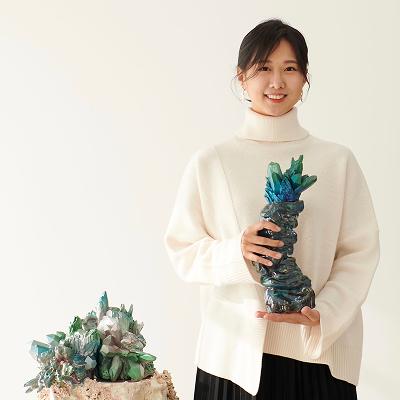
오세린은 거의 완성됐지만 상품이 되지 못한 도자기와 한때 쓰였지만 지금은 버려진 장식품에 주목합니다. 작가는 사물이 어떤 기준으로 선택되고 버려지며, 쓰임을 잃은 뒤 어떻게 새로운 가치를 얻게 되는지 살펴봅니다.
영상 〈중국! 경덕진!〉은 작가의 이웃이 오래전 구입한 경덕진 찻잔 세트에서 시작됩니다. 작가는 중국 경덕진의 도자 공단을 조사하던 중 한국으로 수출되는 유골함 공장을 방문합니다. 영상은 유골함의 생산과 검수, 작은 결함이나 규격 차이 때문에 버려지는 도자기들을 따라갑니다. 막연한 이미지였던 경덕진은 영상 속에서 생산과 노동, 폐기가 일어나는 실제 장소로 구체화됩니다.
함께 선보이는 〈불에서 나온 것들〉, 〈앵무새가 지켜보는 곳〉, 〈가만히 남은〉, 〈가장자리의 형태〉는 이 조사에서 출발했습니다. 작가는 검수에서 탈락한 도자기와 유행이 지난 액세서리, 모조 보석, 조개껍데기 같은 사물의 형태를 도자와 금속으로 다시 만들고 조합해, 감상용 돌인 수석을 떠올리게 하는 낯선 조각으로 바꿉니다.
조각 위에 모여 있는 작은 형태들을 눈으로 따라가 보세요. 모조 보석과 조개껍데기, 장식품을 닮은 형태들이 도자 표면에 달라붙어, 마치 자라나는 생물이나 오래된 잔해처럼 보이기도 합니다. 이 작은 형태들은 틀을 이용한 캐스팅 방식으로 반복해 만들어집니다. 대량생산과 밀접한 방식을 느린 손작업으로 바꾸면서, 작가는 생산의 속도와 효율, 그리고 사물의 가치를 다시 생각하게 합니다.
선택받지 못했거나 쓰임을 잃은 사물들이 전혀 다른 모습으로 다시 나타난 이 조각들을 바라보며 생각해 보세요. 어떤 것은 가치 있는 것으로 남고, 어떤 것은 버려지는 걸까요?
Serin Oh focuses on ceramics that were nearly finished but rejected as products, as well as ornaments that were once used but are now discarded. She examines how objects are selected or rejected, and how those that have lost their original use can take on new value.
The video China! Jingdezhen! begins with a set of Jingdezhen teacups that the artist’s neighbor bought years ago. While researching the ceramic factory districts of Jingdezhen, China, Oh visited a factory producing funerary urns for export to Korea. The video follows the production and inspection of the urns, as well as ceramics discarded because of minor defects or differences from standard dimensions. Previously known to Oh only through an old tea set and a vague image, Jingdezhen becomes, through the video, a real place of production, labor, and waste.
The accompanying works, Out of the Fire, Where the Parrot Watches, Still, and Forms at the Edge, grew out of this research. Oh recreates the forms of rejected ceramics, out-of-fashion accessories, imitation gems, and shells in ceramic and metal, combining them into unfamiliar sculptures that recall traditional viewing stones, or suseok.
Follow the small forms clustered across the sculptures. Shapes resembling imitation gems, shells, and ornaments cling to the ceramic surfaces, at times evoking living growths or old remnants. These small forms are repeatedly made using molds and casting techniques. By turning a process closely associated with mass production into slow, repetitive handwork, Oh invites us to reconsider the speed and efficiency of production, as well as the value of objects.
As you look at these sculptures, where rejected objects and things that have lost their use reappear in entirely different forms, consider this question. Why do some things remain valuable while others are discarded

