


[Chapter.1] Maja Quille
ENG
Maja Quille explores how materials that are discarded or easily overlooked can take on new value. While researching coal and carbon at the Natural History Museum in London, she came across London Clay buried beneath the city. This encounter led her to see clay as a record of long stretches of time and the changes a city undergoes.
You first encounter What Cannot Settle, a new work in which magnetism keeps pieces of unfired clay in constant motion. Follow the movement of the clay. The pieces slide and tremble, draw closer, and collide, creating unexpected patterns of movement and interaction. Listen, too, for the small sounds they make as they collide. As the pieces move, stop, and move again, the sounds form a subtle rhythm of their own.
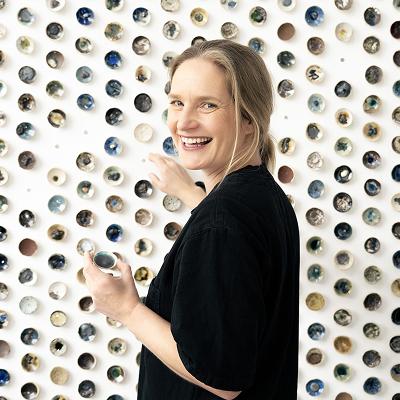
With The Patience of Matter, the perspective shifts to a much longer timescale. Quille is interested in the idea of “technofossils”—the possibility that the materials and waste we leave behind today may remain in the ground as part of the geological record of the distant future. She fires waste together with geological materials from different places at high temperatures inside small ceramic vessels, creating unfamiliar surfaces and crystalline formations. Look at the surfaces of the small vessels alongside the microscopic images displayed beside them. Magnified, they resemble satellite images or mineral landscapes, allowing discarded matter to be seen anew as material that could one day help form the ground of the future.
The two works explore material change across very different timescales. While What Cannot Settle shows clay changing in the present moment, The Patience of Matter extends that process of change far into the future. Imagine what kind of geological record the materials we leave behind today might become part of in the distant future.

